 Here's a picture I took last week while I was in London.The foundations of the Globe were rediscovered in 1989. Led by the vision of Sam Wanamaker, workers began construction in 1993 on the new theatre near the site of the original (about 200 meters). The latest Globe Theatre was completed in 1996; Queen Elizabeth II officially opened the theatre on June 12, 1997 with a production of Henry V. The Globe is as faithful a reproduction as possible to the Elizabethan model, seating 1,500 people.
Monday, April 23, 2007
THE GLOBE THEATRE, LONDON
Here's a picture I took last week while I was in London.The foundations of the Globe were rediscovered in 1989. Led by the vision of Sam Wanamaker, workers began construction in 1993 on the new theatre near the site of the original (about 200 meters). The latest Globe Theatre was completed in 1996; Queen Elizabeth II officially opened the theatre on June 12, 1997 with a production of Henry V. The Globe is as faithful a reproduction as possible to the Elizabethan model, seating 1,500 people.

Wednesday, April 04, 2007
WINDERMERE, CUMBRIA

After watching the film MISS POTTER it's time for me to show you a beautiful picture of Windermere. Windermere is the largest natural lake in England, and is entirely within the Lake District National Park. It has been one of the country’s most popular places for holidays and summer homes since 1847, when the Kendal and Windermere Railway built a branch line to it.Oh just a detail ‘mere’ means ‘lake’.
Tuesday, March 27, 2007
THE LONDON EYE (2)

The British Airways London Eye, also known as the Millennium Wheel, opened in 1999 and is the largest observation wheel in the world. It stands 135 metres high on the western end of Jubilee Gardens, on the South Bank of the River Thames in Lambeth in London, between Westminster and Hungerford Bridges. The wheel is adjacent to London's County Hall, and stands opposite the offices of the Ministry of Defence.
Wednesday, March 14, 2007
MYSTERY PICTURE (5)

Now it is your turn to give me all the details you can find on this picture. The name of the place and the region... Good luck!!
Monday, March 12, 2007
MILLENIUM BRIDGE, LONDON

London's Millennium Bridge is the first pedestrian river crossing over the Thames in central London for more than a century. It is a 325m steel bridge linking the City of London at St. Paul's Cathedral with the Tate Modern Gallery at Bankside. Have you walked over it? What were your impressions?
Monday, March 05, 2007
LIVERPOOL, MERSEYSIDE

There's no better way to experience Liverpool and Merseyside than from the deck of the famous Mersey Ferry. Take the ferry across the Mersey to learn about the region's fascinating history, see its spectacular sights and discover its unique character.
Monday, February 19, 2007
DURHAM CATHEDRAL, COUNTY DURHAM

County Durham is a county in north-east England. Its county town is Durham. It is a county of contrasts: the remote and sparsely populated dales and moors of the Pennines characterise the interior, while nearer the coast the county is highly urbanised, and was once dominated by the coal mining industry.
The form of the county name is unique in England. Many counties are named after their principal town, and the expected form here would be Durhamshire. The reason it is called County Durham instead is that the Bishops of Durham historically exercised power in regions outside the county as well, so the inner part was named County Durham as opposed to the rest of the estate of Durham. The form County X is standard for Irish counties, with no such significance or relationship.
Friday, February 16, 2007
THE RING OF KERRY, IRELAND

The Ring of Kerry is a tourist trail in County Kerry, south-western Ireland. The route covers the 170 km circular road, starting from Killarney, the Iveragh peninsula and passing through Kenmare, Sneem, Waterville, Cahersiveen and Killorglin. The most popular points include Muckross House, Staigue stone fort and Derrynane House. Just south of Killarney, don't miss Ross Castle, Lough Leane, and Ladies View (a panoramic viewpoint).
It passes through some of the most beautiful scenic areas of the country. The trail crosses a wide variety of terrain but, due to onging land access issues, avoids climbing the highest peaks of the mountains. The Kerry Way roughly follows the scenic driving route of the Ring of Kerry.
Wednesday, February 14, 2007
LONDON, SNOW

When men were all asleep the snow came flying,
In large white flakes falling on the city brown,
Stealthily and perpetually settling and loosely lying,
Hushing the latest traffic of the drowsy town;
Deadening, muffling, stifling its murmurs failing;
Lazily and incessantly floating down and down:
Silently sifting and veiling road, roof and railing;
Hiding difference, making unevenness even,
Into angles and crevices softly drifting and sailing.
ROBERT BRIDGES
Sunday, February 04, 2007
CERNE GIANT, DORSET

The Cerne Giant is a rampant, naked 60 metre male carved into the chalk hillside near Cerne Abbas, an old village about 8 miles [13kms] north of Dorchester, in Dorset. The picture shows as much of the giant as you will currently see unless you rent air transport; the carving becomes a lot more indistinct from close up. For scale you can see a couple of hikers at the top of the hill on the left.
There are three main theories as to when and why the giant was produced.
1) He was cut out 4,000 years ago in honour of a Celtic fertility god, Cernunnos. Above his head is a maypole mound that was central to pagan May Day festivities until 1635, when the church decided that the wild, all-night, get naked scenes that were enjoyed by locals in the adjacent woods should be discouraged.
Legend said that barren couples who wish for children should copulate on the giant genitalia.
2) He was carved 1,500 years ago in honour of the Roman god Hercules.
3) He appeared a mere 350 years ago and is a caricature of Oliver Cromwell [1599-1658].
The reason that the giant's origin is unclear is first because the only elements remaining in the area are grass and chalk which have been around for months or millenia, so carbon dating is not an option and second because the earliest written record of the giant that survives was in the 18th century.
Friday, January 26, 2007
MYSTERY PICTURE (4)

Let's have another go.....
Where is it?
What's the exact name of this place?
Good luck!!
Monday, January 22, 2007
CASTLETON, DERBYSHIRE

Here's a picture from a county that I'm fond of: Derbyshire.
This ancient lead - mining village is one of the most popular in the Peak District. There are separate spectacular caverns. The village itself is a delightful cluster of stone cottages and interesting inns, ringed by the limestone hills. It sits beneath the protection of a castle keep known as Peveril Castle. Built in Norman times by William I.
Castleton is a very popular place with visitors. This may be due to Castleton having almost everything a visitor could want. It has spectacular scenery. There are good walks for everyone, a pretty village, and many events throughout the year.
Monday, January 15, 2007
BOURNEMOUTH, DORSET

Bournemouth is one of Dorset's newest towns in more ways than one. Prior to the 19th Century it did not exist, not one single house existed where the town stands today. It is located about 107 miles southwest of London. Dorset is one of England's most unspoilt counties. How about visiting it ??? In the meantime, enjoy this funny picture of SIGNS, which looks like an invitation to a hike.
Wednesday, January 10, 2007
BATH, SOMERSET

This stunning city is one of England's most beautiful places to visit.
Bath is unique with its hot springs, Roman Baths, splendid Abbey and Georgian stone crescents. It has attracted visitors for centuries. Set in rolling Somerset countryside, just over 100 miles west of London, it is a beautiful and unforgettable place to visit.
Sunday, December 31, 2006

Thursday, December 28, 2006

Thursday, December 21, 2006
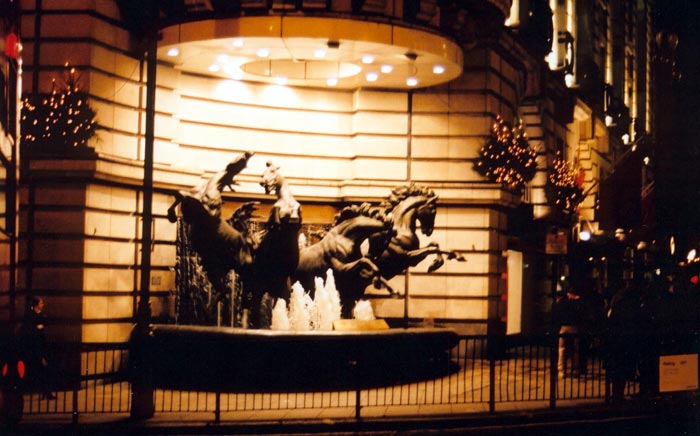
XMAS IN LONDON (1)

Now it's time to think about Christmas and I will post some nice views of the capital.
Here's the first one.
Monday, December 11, 2006
CAMBRIDGE, CAMBRIDGESHIRE

This picture was taken in Bridge street in Cambridge. It is the round Church of the Holy Sepulchre.
This exciting building, created in the 12th century, is one of the only four round churches in England and is a favourite among Cambridge residents. If you visit Cambridge don't miss it...
The chancel, north chapel, and south aisle were all added in the 15th century and the conical roof was added in the 19th century.
Monday, December 04, 2006
HIGHLAND COW, SCOTLAND

I know you really enjoyed the previous picture. So, here's another one. But did you know that Highland cows are the oldest known cattle breed. Records of this breed's existence date back as far as the 12th century.The breed was first imported into the United States in the late 1880s. Highland cows are known for their gentle disposition, hardiness in adverse weather conditions and strong resistance to disease.
Wednesday, November 15, 2006
MYSTERY PICTURE (2)
Try to guess where this picture was taken... I'll be waiting for your questions and answers.
Subscribe to:
Posts (Atom)